
OEM or ODM Jewelry Manufacturing: Which Model Fits Your Brand
The choice between OEM and ODM comes down to a single question: who supplies the design file? In OEM the brand owns the CAD and the factory builds to it; in ODM the factory develops the concept and the resulting collection stays exclusive to the brand. Both routes pass through the same 48-hour CAD stage and 25–30 day sampling window, so the decision is about control and ownership, not about speed.

Key takeaways
- OEM means you design and the factory produces; the CAD and the IP stay with the buyer.
- ODM means you bring the brief and the factory develops the collection, under a 100% NDA and exclusive terms.
- Both models reach sampling in 25–30 days and production in 3–4 weeks, a 48–60 day path overall.
- Per-design minimums do not change with the model: 50 pieces in 925 sterling silver, 100 in brass, 100+ in stainless steel.
The two models, and the sentence that separates them
The shorthand is short enough to memorise. OEM is you design, we produce. ODM is you inspire, we create. In an OEM relationship the buyer arrives with a technical pack, a drawing or a finished CAD file, and the factory quotes the work of turning that file into a physical product. In an ODM relationship the buyer arrives with references, a mood board or a commercial gap, and the factory carries the idea through concept development, CAD, prototyping and sampling into a collection.
Neither route is a maturity level. A large brand with an in-house design studio still uses ODM when it wants a factory to interpret a trend quickly. A small label with one strong idea uses OEM because it already knows exactly what it wants made. The model should follow the asset the brand actually holds.
A useful test is to imagine the first revision request. If the buyer can redraw the change, OEM is the natural fit. If the buyer can only describe the effect — a softer curve, a smaller stone, a lighter band — the relationship is already ODM, because someone has to translate the description into geometry. Most first collections sit in the second category, and most second collections move toward the first.
Who owns the file, and why it decides the model
CAD ownership drives everything downstream: who can reproduce the piece, who can modify it, and what happens when the relationship ends. Under OEM the buyer's CAD is the source of truth and the intellectual property stays with the buyer. Under ODM the concept is developed with the factory, so exclusivity has to be written into the agreement instead of assumed from authorship. The terms that make this workable are a 100% NDA, moulds and CAD files that are not resold, and a collection that is not shown to other brands.
Ask for those three points in writing before sampling begins, not after. A supplier that will not commit to exclusivity in the quotation stage will not commit to it once the mould exists.
| Point | OEM | ODM |
|---|---|---|
| Design source | Buyer's drawing, tech pack or CAD file | Factory development from buyer references |
| IP position | 100% buyer-owned | Collection exclusive to the brand under NDA |
| CAD stage | Review and production modelling of the supplied file | Concept to CAD, returned in under 48 hours |
| Sampling | 25–30 days from approved CAD | 25–30 days from approved CAD |
| Fits a brand that has | A finished design and a spec | A brief, a reference set or a gap in the range |
Process control under ISO 9001:2015, in both directions
The quality system does not care which model produced the file. ISO 9001:2015 covers quality management across all production stages, and the eight factory steps run the same way whether the design arrived from the buyer or from the factory's own studio: concept and CAD, prototyping by mould or 3D printing, sprue cutting, polishing, surface art, electroplating, 100% final inspection and delivery. What changes is who signs the concept off and who holds the file afterwards.
That is why a brand with a finished drawing is looking for an OEM jewelry manufacturer rather than a design partner, while a brand with a mood board needs the development side of the same house. TTT Jewelry runs both under one roof, with a dedicated project manager on each account and a 24-hour response window. Minimums stay the same either way: 50 pieces per design in 925 sterling silver, 100 in artisan eco-brass, 100+ in stainless steel.
The OEM/ODM flow is published as six steps: inquiry, consultation and development, CAD and prototype in under 48 hours, sample and approval in 25–30 days, bulk production, then final QC and delivery with 100% inspection. The first two steps are where the model is settled, because consultation is also where feasibility, material choice and cost structure get defined. TTT Jewelry describes itself as a factory-direct supplier working since 2010, with 15+ years of OEM/ODM experience, which is the point at which a buyer should ask which of the two models the factory is actually quoting.
Worked example
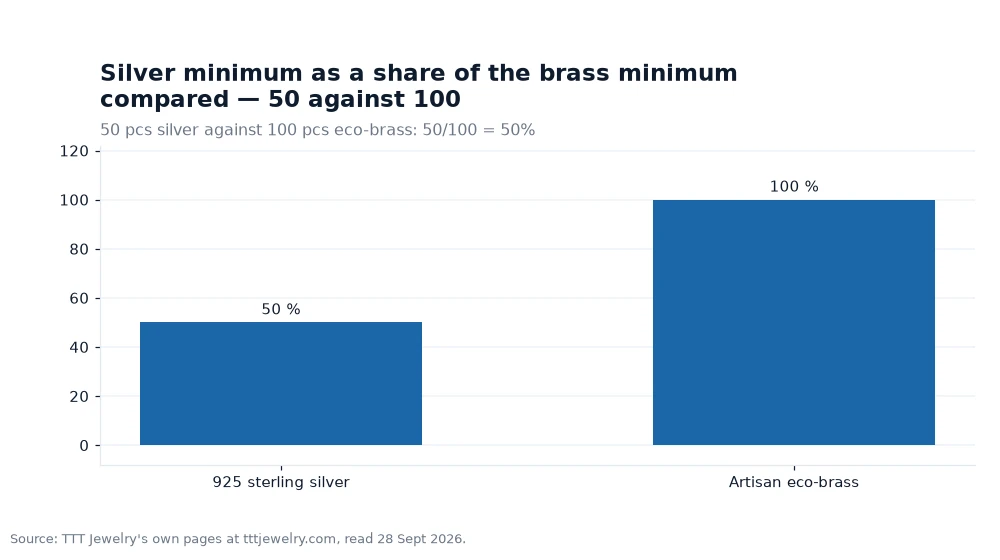
A brand wants three brass designs. Under ODM it hands over references and receives three CAD models at under 48 hours each, so the modelling stage is 2 days if the briefs go out together. Sampling then runs 25–30 days for all three in parallel, and production runs 21–28 days: 2 + 25 to 30 + 21 to 28 = 48–60 days. The minimum is 3 × 100 = 300 brass pieces. Under OEM the same brand supplies its own three CAD files. The factory still samples for 25–30 days and still produces for 21–28 days, so the calendar is unchanged at 48–60 days, and the minimum is unchanged at 300 pieces. The difference is not time or volume; it is that the buyer has carried the design work itself and keeps the file. Re-run the same three designs in silver and the minimum falls to 3 × 50 = 150 pieces, which is 50% of the brass figure — a larger effect on a first order than the choice of model.
Frequently asked questions
Can a brand start with ODM and move to OEM later?
Yes, and it is a common path. The first collection is developed with the factory under NDA, then the brand builds its own design capability and arrives at the next collection with CAD files. The manufacturing steps and the 25–30 day sampling window stay the same.
Who owns the moulds and the CAD files?
Under OEM the buyer's CAD remains the buyer's property. Under ODM the collection is developed for the brand and held exclusively, with a 100% NDA covering moulds, CAD and the collection itself. Either way, the agreement should state that nothing is resold or shown to another brand.
Does ODM mean the factory can sell the design to someone else?
Not under the terms described here. ODM work is exclusive to the brand, and the moulds, CAD files and finished collection are not resold or displayed for other clients. Exclusivity is the reason ODM is worth paying for; without it the model is just anonymous sourcing.
Deciding before the first brief
Write down what the brand already owns — a drawing, a reference set, a trend direction, a licensed artwork — and the model selects itself. If the answer is a finished file, the conversation is about tooling, tolerance and schedule. If the answer is a folder of screenshots, the conversation is about development. Either way, the first commercial document should be a custom jewelry wholesale quotation that names the model, the metal, the minimum and the sampling window, so the brief and the contract describe the same project.
Source note: figures come from the manufacturer's own website (tttjewelry.com), read 28 Sept 2026.[1]